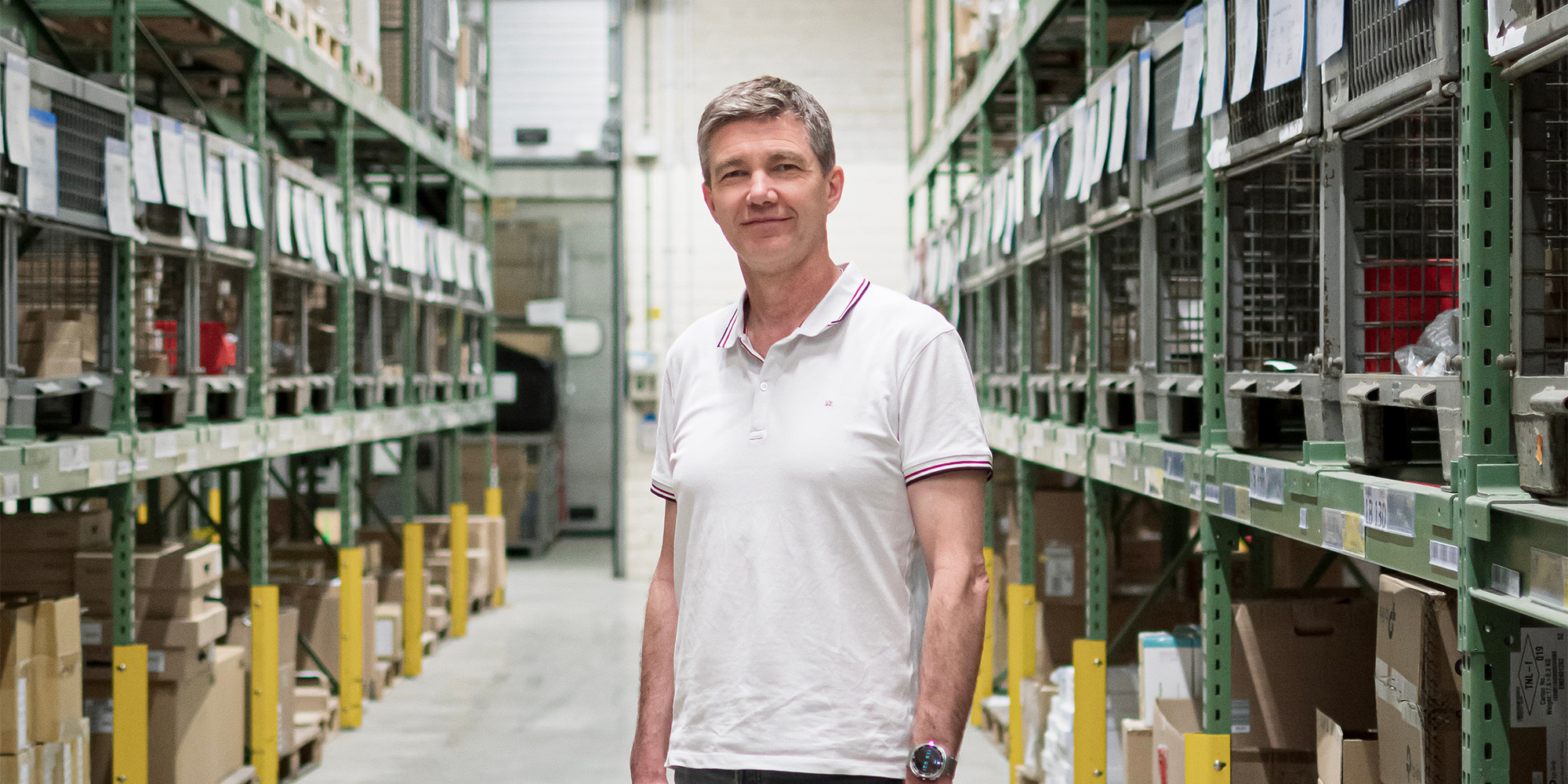
Giving TV set-top boxes and routers a new lease of life rather than systematically replacing them… What began as a response to a shortage has become a genuine circular economy initiative within POST Telecom. Now overseen by Pierre Woeffler and his teams, refurbishment helps to reduce waste, conserve resources and keep costs down.
It was in 2021, when POST Telecom was facing a supply issue with TV set-top boxes, that the idea of refurbishing equipment emerged. ’Due to a shortage of electronic components, delivery times for set-top boxes had lengthened considerably, to the point where it was becoming difficult to provide new customers with equipment,’ explains Pierre Woeffler, stock administrator at POST Technologies. ’At the time, POST decided to set up a project with the Ligue HMC to refurbish set-top boxes collected from customers and thus meet demand.’
Cette initiative répondait avant tout à un besoin opérationnel. Elle allait toutefois révéler un potentiel beaucoup plus large.
A meaningful partnership
Founded in 1963, the Ligue HMC supports people with intellectual disabilities to promote their social, professional and cultural inclusion.
« ’Together, we have implemented a project that had a social dimension, was part of an environmental initiative and met a genuine business need,’ continues Pierre Woeffler. ’This refurbishment initiative provided people with disabilities with employment opportunities. For two years, a team from the Ligue HMC collected set-top boxes returned by certain customers to test, refurbish and extend their lifespan. »
The results far exceeded initial expectations. By 2025, 65 per cent of the ‘POP TV’ set-top boxes installed in customers’ homes were reconditioned. ’Above all, this initiative made us realise that many devices, which were still in perfect working order, could be recovered and put back into circulation. We therefore wanted to make this approach standard practice,’ adds Pierre Woeffler.
Making the circular economy a reflex
As older set-top boxes were gradually replaced by new models, the approach was extended to other equipment such as routers, ONT (Optical Network Termination) units – which convert the light signal from the fibre optic cable into an electrical signal – and Wi-Fi repeaters.
Today, all equipment collected from customers by technicians is systematically returned to stock for analysis.
Twenty minutes for a new lease of life
Each device undergoes a rigorous inspection procedure. ’In addition to a visual inspection, functional tests are carried out according to a precise protocol. If the equipment is in working order, it is cleaned and then repackaged with the necessary accessories before being returned to stock’ explains Pierre Woeffler.
It takes around twenty minutes to recondition a device.
This approach represents a genuine paradigm shift. In the past, most of the recovered equipment was disposed of as electronic waste. ’Today, we know that a large proportion of these devices are still fully functional. We even now find that reconditioned equipment is returned to us and can be put back into service,’ he adds.
POST Telecom now prioritises a circular approach based on the reuse of equipment. ’Our customers are, first and foremost, buying a service. The equipment supplied to them is simply a means of accessing that service. Therefore, when it can be reused, it makes sense to give it a second life,’ continues Pierre Woeffler.
A virtuous approach on every level
Refurbishment directly helps to limit the production of electronic waste and reduce the consumption of new resources. The approach also offers significant economic benefits, as the cost of refurbishment is lower than that of purchasing a new device.
’When a piece of equipment can be brought back into service two or three times, the savings quickly add up. It’s a virtuous approach: it benefits the environment whilst remaining economically viable,’ emphasises Pierre Woeffler.
This reality is now a real source of motivation for the teams. ’It is particularly rewarding to see that an initiative originally put in place to address a supply issue has become a concrete means of reducing our environmental impact whilst creating value,’ he says.
Changing practices
To maximise the benefits of refurbishment, refurbished devices are systematically given priority in new installations. ’For the system to be fully effective and operate efficiently, everyone must be made aware of these issues. Refurbishment does not depend solely on the person responsible for checking, cleaning and repackaging the equipment. The technicians who collect the equipment also play a vital role in sorting and channelling the devices,’ explains Pierre Woeffler.
This approach has gradually changed working practices within the company.
’It has also helped to influence procurement policies,’ adds Pierre Woeffler. ’When selecting new equipment, POST Telecom pays particular attention to its reliability, reparability and the recycling options available at the end of its life.’
An approach now firmly embedded in our processes
Defective devices or those that have reached the end of their useful life are channelled into appropriate recycling schemes.
What began as a response to a shortage has now become second nature within POST, and this is undoubtedly the project’s greatest success: demonstrating that a more circular approach can simultaneously reduce environmental impact, generate savings and rally teams around a common goal. This approach is now fully integrated into the company’s processes.
Good to know
At POST, the circular economy is also put into practice in the management of IT equipment. Thanks to the take-back programme set up by Cisco, one of our suppliers, certain end-of-life equipment can be recovered by the manufacturer so that its components and materials can be reused.
On the initiative of Nicolas Stefko, the IT team was the first to benefit from this scheme: ’We’ve moved from a model where we paid to dispose of our old equipment to one where the manufacturer recovers it.’
Whilst this approach requires inventory work and administrative management, the benefits are real: less waste, better utilisation of resources and a financial gain for the company.